
Receive new posts as email.

| Sun | Mon | Tues | Wed | Thurs | Fri | Sat |
|---|---|---|---|---|---|---|
| 1 | 2 | 3 | 4 | 5 | 6 | 7 |
| 8 | 9 | 10 | 11 | 12 | 13 | 14 |
| 15 | 16 | 17 | 18 | 19 | 20 | 21 |
| 22 | 23 | 24 | 25 | 26 | 27 | 28 |
This site operates as an independent editorial operation. Advertising, sponsorships, and other non-editorial materials represent the opinions and messages of their respective origins, and not of the site operator.
Entire site and all contents except otherwise noted © Copyright 2001-2009 by Glenn Fleishman. Some images ©2006 Jupiterimages Corporation. All rights reserved. Please contact us for reprint rights. Linking is, of course, free and encouraged.
Powered by
Movable Type
This article seems to indicate that broadband is still mostly in the hands of the better-off in the developing world: Still, the overall point is that growth and availability has surged in the last few years, partly due to the decrease cost of technology, and partly due to the increase cost of copper. The latter seems paradoxical, but it's apparently now cost effective to lay fiber optic cable because of copper's high cost. (This cost is extremely granular: a contractor friend about to work on our basement said that costs could change by a decent amount on materials for some part of the job due to copper price fluctuations.)
One industry exec says that the developing world is starting to feel the same boom that the Europe and North American experienced in 1999--when broadband went from a tiny minority that were early adopters or in the right place at the right time to widescale availability coupled with price drops. Venezuela has installed 500,000 broadband connected over the last 2 1/2 years, but will hit a million by the end of 2007. Argentina leapt from 115,000 to 841,000 lines over three years (as of last year). India has just 1m broadband users, unbelievably, and WiMax is widely seen as a tool to push users onto the Net.
Posted by Glenn Fleishman at 2:45 PM | Permanent Link | Categories: Broadband Wireless, Mainstream Media | No Comments | No TrackBacks
Clearwire announced a major expansion of their market to cover the Seattle region: The company offers broadband wireless service in a number of US markets, but Everett-Seattle-Tacoma is the biggest single one they have so far. "With the launch of this market, the greater Puget Sound area, we will be making our services available to another 2m people," said Ben Wolff, the company's co-CEO and co-president, in a briefing last week. Clearwire now serves 360 towns in 32 markets internationally.
(You can hear me discuss this story on KUOW-FM's The Conversation, aired today in the Seattle market, and archived here; my comments start about 20 minutes into the program.)
Wolff said that while the perception is that Clearwire was working the rural Chatauqua, that's no longer the case. "We have certainly built markets that are underserved markets, but if you look at our market today, the vast majority of customers in our market have access to both cable and DSL," he said.
When queried about their current potential coverage area, previously stated by the firm as being comprised of 2.5 GHz spectrum licenses passing 90m Americans, Wolff said that was outdated information. The 90m figure was "at the point in time that we filed our S-1 registration statement" when the firm was planning a potential initial public offering. Clearwire's current spectrum footprint is "dramatically larger," Wolff said, declining to provide additional detail.
Clearwire is competing with wireline broadband firms, but has a significant disadvantage in terms of speed, offering just 1.5 Mbps down and 256 Kpbs up as the top rate ($38 per month, $25 setup, $5/month modem rental or $100 purchase). A lower rate of 768/256 Kbps has the same modem fees and runs $30 per month with a $50 setup fee. A three-month introductory promotion is $20 per month for either level of service.
Much higher rates, up to 5 or 6 Mbps with DSL and cable in parts of many markets, are now available at higher cost. The Seattle Times published a fantastic chart showing what bandwidth costs from many providers in the Seattle area. 6 Mbps over 384 Kbps is $42.95 from Comcast and 5 Mbps over 896 Kbps is $36.99 from Qwest. Of course, this means that you have to qualify for those speeds in the place you live, too, which varies remarkably over metropolitan areas.
On the other hand, Clearwire has the advantage of mobility and simplicity. Wolff noted, "You can go into one of our retail stores today or order over the Web and get provisioned. As soon as you have the modem in your hand," plug it into power, the connection is active. Wolff joked, "It's so simple that even an adult can do it."
Clearwire's service is also nomadic, with the small-format modem working anywhere in the coverage range, and supporting a car-power adapter. This makes it appropriate for a host of mobile occupations, including real-estate agents and a variety of municipal employees. A company spokesperson separately noted a variety of uses of Clearwire in other markets, such as providing a mobile hotspot on buses in Anchorage, providing a method for a local newspaper's photographers to file pictures from the field, allowing mobile classrooms, and giving boat owners access without pulling a wire of any sort.
While cellular data networks offer even higher degrees of mobility with battery-powered portability, the cost is much higher for less throughput, and cellular operators are fixated on the smartphone and the adapter in the laptop--not on a nomadic networked device. Clearwire expects its users will watch videos, share their connection with other computers in the same household, and be used just like a broadband wired connection. Clearwire's acceptable use policy requires users to avoid certain kinds of excessive use, which are fairly reasonable. You can't operate a high-volume Web server, nor can you continuously stream video or transfer files via FTP upstream or downstream.
These guidelines are distinctly at odds with the restrictive terms and services of, say, Verizon Wireless, which expects less than 5 GB of data transfer per month, and contractually allows only Web browsing, email, and intranet application use with its EVDO service. Perry Satterlee, co-president of the firm, said in regards to the company's limitations on user activities, "Because of the nature of our product, we have a much bigger pipe that's available." He noted, "We see ourselves as filling a gap in the marketplace that isn't filled in any other way today."
Wolff said that Clearwire expects to be the affordable backhaul for hotspots, too, offering a complementary service to local Wi-Fi access. And with regards to the metro-scale Wi-Fi networks that are being built today, "You'll see us find ways to integrate and cooperate with the muni-Wi-Fi movement."
Clearwire's expansion brings some concerns that a high customer uptake could congest the network. Wolff dismissed this, noting the efficiencies of their technology choice for managing spectrum. "We are going about building our network today [in a way] that will more than absorb the customers and usage that we expect to see for some time," he said.
Update: A couple minor notes on Clearwire from the Seattle Times' Tech Tracks blog. First, you can use a powerline networking system to distribute incoming access around a home via power outlets. Second, the company employs two security methods: encryption for the local link and obscurity through licensed spectrum.
Posted by Glenn Fleishman at 10:48 PM | Permanent Link | Categories: Broadband Wireless, Metro-Scale Networks | 1 Comment | No TrackBacks
Clearwire competing for hearts, minds of less-served audience: With licenses that allow their broadband wireless service to operate only in mostly less-dense and less-populated areas of the US, Clearwire is clearly trying to address that market. This article from the Anchorage Daily News details a reporting trying out a 90-day program on one bus, in which Wi-Fi service is relayed to the Internet over Clearwire's network. On one route, the reporter experiences some carsickness, enjoys people watching, and sees no other laptops in use. (My only bout of carsickness also arose from trying to use a laptop in the backseat of a car.) On a straighter route, he finds less nausea, but also loses the signal.
Posted by Glenn Fleishman at 11:55 AM | Permanent Link | Categories: Broadband Wireless, Municipal | No Comments | No TrackBacks
 A few weeks ago, I noticed that a second broadband wireless ISP was announced in midcoast Maine: I wrote about this at the time, as it seemed remarkable that an area with just tens of thousands of residents could support two firms. The companies' founders both commented on that post, and that's interesting reading, but I wanted to hear some additional detail. I got Jim McKenna, the founder of the newer firm, on the phone to chat about the advantages of wireless mesh in areas where real estate rights are easier to obtain, mountains abound, and customers have few other options. That's featured in today's 20-minute podcast. (Yes, I kept a podcast under 40 minutes.) [20 min., 10 MB, MP3]
He pointed out in the interview that the numbers for Maine are pretty staggering bad for broadband adoption, and he thinks it's about price. He said that one survey showed that only 10 percent of households passed by DSL or cable subscribed to that service. Maine is not only a poor state, it's largely rural, and I would guess that out of 1.3m residents and over 500K homes, that perhaps only 30 to 40 percent are passed by DSL or cable.
The largest cities in Maine--Portland, Augusta, and Bangor--have about 20 percent of the state's population. Everyone else is spread out. In Knox County, where Red Zone Wireless and the 1995-founded Midcoast Internet Solutions have their headquarters about two blocks from each, there are only 40,000 residents, and about a quarter live in and around Rockland, the county seat.
McKenna says that $20 per month is the right price point, and Red Zone offers a residential Wi-Fi-based service with broadband rates for that price and $50 setup; no contract, no cancellation fees, either. That's 500 Kbps down and 128 Kbps up, or about 10 times the download and four times the maximum speeds of a 56K modem. (Although when you get to some of the towns in Red Zone and MIS's coverage area, you're not seeing modem rates that high, either.)
I have a query out to talk to Midcoast Internet Solutions's founder, too, to compare notes. They started as a dial-up provider in 1995, and added Breezecom (now Alvarion) wireless gear in 1997.
Posted by Glenn Fleishman at 10:37 AM | Permanent Link | Categories: Broadband Wireless, Podcasts, Rural | No Comments | No TrackBacks
NuTel's plan is to work with existing ISPs or entrepreneurs to set up wireless broadband in small and medium sized communities: The company will handle the backend--accounts and support--while the local firm will own the customer. The plan is to organize a separate company in each community with Nutel as the managing partner. NuTel will handle bringing in broadband and mounting gear; they'll use SkyPilot equipment. They want partners who are qualified to handle truck rolls.
NuTel appears to be also following SkyPilot's original dream of customer-mounted mesh networks. Rather than negotiate with cities and utilities, SkyPilot--when it was a mesh network builder that made its own equipment rather than solely an equipment vendor--wanted to use each customer's location as a possible extension to the mesh. Their equipment supports this, but the companies that deploy their gear haven't pursued this original dream to that extent. NuTel appears to want the right to mount mesh extenders on customer buildings and houses.
The company has 8 to 10 operating partners lined up, they say in this Wi-Fi Planet article, and think they could hit 200 by the end of 2007. They wouldn't compete with municipal networks; this is a final-mile play in broadband-scarce areas.
Pricing could run about $60 per month for 1.5 Mbps access and VoIP service or as little as $15 per month for a 200 Kbps dial-up replacement. Other rates will be available. They expect to work in a 14-state area, including parts of the Mississippi Valley, the upper Midwest, Texas, and California.
Their VoIP service isn't Internet-traversing telephony, but VoIP to their network operation center where traffic is segregated out. This is how some DSL and cable firms handle VoIP, too, providing a much more predictable quality of service from home to PSTN.
Posted by Glenn Fleishman at 2:50 PM | Permanent Link | Categories: Broadband Wireless, Municipal, Rural | No Comments | No TrackBacks
Jesse Drucker files this column in the Wall Street Journal about the U.S.'s pitiful broadband performance with private capital in charge: In France, $36 per month can buy you 20 Mbps download speeds, 100 channels of TV, and unlimited domestic Internet telephony. Drucker states--in what is sure to provoke an Opinion Page response--that strict rules to allow carriers to open up their lines to competitors is the reason.
Incumbent telcos and cable firms operate 93 percent of the U.S. broadband, which the FCC defines as 200 Kbps or higher in one direction. Ha!
There's no mention of George Gilder, massive telco fraud, and horrible investments in this column, but that might take entire books. The failure of broadband can be tied to the obsession in overbuilding fiber under the assumption that it would carry only slightly more data over time, and the telephone and cable companies terrible, sometimes allegedly illegal decisionmaking processes in the late 90s and early 2000s. They got distracted from their core businesses.
Drucker gives a zinger near the end of this column to anyone who wants to complain about the municipal networks being funded by taxpayer dollars, although few have any taxpayer money going towards buildout or operation: "Phone companies, for example, get billions of dollars in federal and state subsidies for rural service; they also have teams of lobbyists and attorneys to influence policy. As cities try to introduce competing wireless networks, traditional telecom providers lobby to restrict such plans."
Let's not forget those billions which extend far beyond rural service--that's just one piece of it. Folks who believe in not having competition from municipalities with incumbents forget that municipalities are directly and indirectly funding (through subsidies and tax breaks) those very entities.
The removal of tax revenue from entities is the same as spending taxpayer money--it goes to the entities' shareholders instead of into the pockets of local residents.
Posted by Glenn Fleishman at 4:06 PM | Permanent Link | Categories: Broadband Wireless, Mainstream Media, Municipal | 2 Comments | No TrackBacks
I wrote a few days ago about BelAir's introduction of mesh Wi-Fi designed to plug into existing cable television wiring systems: Jim Thompson has more. Jim has worked in the Wi-Fi space nearly since its introduction, building out networks for Wayport in the 90s, heading up engineering efforts at Vivato's Spokane office, and building open-source network projects. He currently runs NetGate from his hardship-duty in Hawaii.
He sent in these remarks on how cable + Wi-Fi benefits MSOs (Multiple Systems Operators), or cable companies that own a number of networks. I'll urge readers to remember that these are Thompson's opinions, but that I generally share
1. No spectrum costs. WiMax in unlicensed spectrum is a joke. (City-wide 'mesh' using 802.11 is a joke for similar reasons.)
2. No backhaul interference issues. Want to guess at the native data rates available in DOCSIS 2.0 [the current dominant cable Internet standard]? Around 30Mbps upstream, and just under 40 Mbps downstream. A nice match for 802.11g.
3. Cable MSOs could offer city-wide "hot spot" service, cleaning the clock of any incumbent ISP. They could start where this makes the most sense, and build out from there.
4. Cable companies already own rights to the poles and building entrances. MSOs don't have to re-negotiate with the municipality, they don't have to lay new cable.
As Thompson notes, cable companies already possess rights--they already have franchise agreements. They already pay cities and towns tax based on their revenue and for rights of way. The Broadband over Powerline (BPL) market hasn't taken off as predicted partly because electrical utilities aren't ISPs and the have to build out a variety of infrastructure that's not in place. By contrast, cable companies are virtually all ISPs: they can pop radios in and start offering service. No real estate issues, no back-haul spectrum issues, no startup costs in building out ISP infrastructure for account handling and bandwidth.
Posted by Glenn Fleishman at 10:04 AM | Permanent Link | Categories: Broadband Wireless, Hardware, Municipal | 5 Comments | No TrackBacks
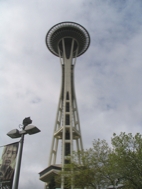 Dramatically, Speakeasy Networks had its formal press announcement for its dense downtown Seattle pre-WiMax network on the observation level: I was there this morning when executives from Speakeasy, Intel, and Alvarion described the components of the new five-building-top pre-WiMax network that blankets downtown Seattle. The network is live today with early customers and will go into a fully available service with 48 hours from order to live network June 15, according to today's announcement. (View photo gallery on Flickr.)
Read the rest of the story at WiMax Networking News.
Posted by Glenn Fleishman at 2:45 PM | Permanent Link | Categories: Broadband Wireless, Metro-Scale Networks, WiMAX | No Comments | No TrackBacks
 A little thought experiment: let's pretend broadband was electricity: The Previous Millennium Research Council today released a report that strongly opposes the entry of municipally owned entities into electrical power generation, distribution, and delivery. The PMRC's report, sent out by telegraph to business centers around this great country, is dated Nov. 1895, although it will take several weeks for sufficient copies to be printed and distributed by rail to business centers.
Electricity is too important a resource for America's future to be left in the hands of cities and towns, the council argues, which are inefficient enterprises that take profits from industry in their pursuit of ever-greater control of the flow of capital within their borders. "How big may these so-called public utilities grow in their efforts to stifle free enterprise and increase the size of government?" the report asks.
The report notes that 97 percent of all neighborhoods in the U.S. have at least one functional electric street lamp running built through private enterprises' effort, and that some urban areas have two electrical lamps on each corner, as well as lighting available at different times of the day and night both within and outside of homes and businesses.
The report dismisses the concern that in many areas, only a small percentage of all buildings are equipped with electricity and rejects the fact that private utilities in some municipalities only provide enough voltage and amperage to power a few dim lights.
His Honor, Mayor Charles Franklin Warwick of Philadelphia has recently said that he intends to provide universal electrical service, but critics argue that merely providing electricity will not ensure that the "electrical divide" will be bridged because poorer inhabitants of cities and towns will not use their hard-earned pittances to pay for electrical appliances, such as a motor-driven wringer or electrical lamp, much less power. And, in any case, most of them are illiterate and work 16-hour days, and thus have no need for the modern wonder of electrical lighting which would merely disturb their few hours of rest each night.
Several authors in the report state that the abiding interest of the community is served best by providing financial and monopoly incentives to existing private utilities to expand their electrical offerings. For instance, Variegated Zandegraaf and Sons received a subsidy of $1 million to substantially increase the flow of electricity through Pennsylvania over the last decade. While it has provided some additional service, the company required additional infusions of millions to complete the task over the next 10 years without the threat of competition which would diminish the utility's motivation.
The PMRC also takes the stand that installing electricity in every home would drain tax coffers, and expects that once projects are begun, the revenue from them might never cover the immense cost of such service. "One might imagine a city building an electrical network that could provide any amount of service at any time of day or not, rather than at particular times that are most advantageous for power generation," the report states.
Businesses are also not interested in electricity, the PMRC states, noting that horses, railroads, coal, and the Irish are the driving forces of the economy. "Providing universal access to electrical power is not a leading consideration in business development," the report says. While certain businesses require electricity, such as theaters or carnivals, business conditions are best improved by well-honed service provided by a single company in each field which reduces the chances of disruption.
One report author did suggest that a new form of ground-transmission technology invented by Nikola Tesla might provide enough energy to be substantially less expensive for a municipality to install but have limited enough utility that both private and public electrical generation could be possible.
The PMRC report comes on the heels of legislation passed in several states that require municipalities to petition the local private utility before they attempt the arduous work of installing electrical plants. If a private utility states that they plan to add power within 30 years, the municipality is required to wait.
Breaking News! This correspondent has learned that PMRC is a paid agent of Issithorp and Dankerbottel, two gentlemen who have contracted with Variegated Zandegraaf and Sons to increase their reputation and improve business conditions on their behalf. Although severely pummeled by Pinkertons, I remain your faithful scribe, and will have further dispatches as they come available.
Posted by Glenn Fleishman at 8:22 PM | Permanent Link | Categories: Broadband Wireless, Municipal | 1 Comment | No TrackBacks
Mike Masnick breaks the news that Nextel is pulling the plug (or lack of plug) on Flarion trial: Mike's eagle eye apparently spotted a blogger noting his Flarion service was being turned off at the end of June. Nextel was trying Flarion's high-speed wireless broadband technology as an option for data service. Nextel's iDEN voice technology doesn't have a data path like GSM and CDMA. Masnick puts the blame on the trial ending on the Sprint/Nextel merger. Sprint has its dollars behind EVDO, the same technology being rolled out quite successfully by Verizon Wireless right now.
Posted by Glenn Fleishman at 8:30 PM | Permanent Link | Categories: Broadband Wireless, Cellular | No Comments | No TrackBacks
The Wall Street Journal exhaustively surveys the lay of the land for broadband wireless deployment: I estimate that this article took a few dozen hours and weeks of reporting--some of which surely found its way into other articles--to pull together because of the number of companies and technologies involved. It's a great overview that focuses on WiMax, metro Wi-Fi, and other broadband wireless as an alternative to the wirebase that's needed by cell companies and service providers who don't own copper.
I particularly like the neat turn of phrase that encapsulates the entire WiMax branding and hype problem: One of the technologies drawing the most attention is WiMAX, which is similar to the popular Wi-Fi standard that millions of people have used to set up wireless networks in their homes but is slated to have a range of several miles. Since WiMAX has yet to be certified, companies are using precursors to the technology.
Exactly. Precursors aren't necessarily worse, but they're not interoperable and they don't bring the benefits of mass-market standardization to reduce the CPE (customer premises equipment) that will ultimately make broadband wireless affordable to the average home instead of a subset.
I love this bit of specious reasoning quoted about the landline side of things that are causing this competitive wireless marketplace to emerge. The Bells argue that they shouldn't be forced to share their lines. "We're incurring all of the costs of building these networks and we don't feel we have to share them with our competitors below what it costs us to build and maintain our network," says BellSouth spokesman Jeff Battcher.
I don't think anyone has ever asked the Bells to subsidize the cost, but rather to provide an accounting that shows the true costs. It's clear that because the Bells can bundle services and make money across an entire customer package that they have every motivation to make their wire costs much higher to discourage having to resell access at a price that allows competition. In other words, if the Bell companies can arrange a markup over costs, why can't they resell at wholesale with a margin for competitors? They can, but they want it to appear as though they can't to preserve their bundling profits.
Also, I guess nobody every explained to Mr. Battcher that monopolies, natural or regulated, are subject to different rules than companies competing without any advantage. The Bells own the wire; they should be forced to share unless you believe that consumers should pay the maximum possible price rather than the optimal price decided on by a marketplace. Those focused on business returns and shareholder value would argue the highest price the market will bear is best; those focused on consumer issues might maintain that more competition would produce an ideal price set by the contention of service in the bazaar.
But broadband wireless coupled with pressure from cable operators has at least forced a semblance of competition with much, much more on the way.
What's most important about the survey of the landscape in this article is that it shows how widespread the tests are already by major firms and how many tens of billions will be poured into all forms of broadband wireless in the very near future.
Posted by Glenn Fleishman at 8:49 AM | Permanent Link | Categories: Broadband Wireless | 2 Comments | 5 TrackBacks
Towerstream issued a press release explaining how the FCC's subsidy ruling pumps broadband wireless: I reproduce their press release after the jump because it's an interesting bit of analysis. The FCC ruled (PDF news release) that incumbent carriers, the Baby Bells et al., no longer need to subsidize competitive carriers in urban areas for their high-speed commercial digital services; this doesn't cover DSL, but rather T-1 (1.544 Mbps) and DS3 (45 Mbps) services. This means, Towerstream says, that the price of a wired T-1 and DS3 loop will increase because it can. Thus, their syllogism goes, it's now even more price competitive to go with their wireless high-speed, high-availability service.
Read the rest of "FCC Ruling Means More Broadband Wireless, Says Towerstream"
Posted by Glenn Fleishman at 3:21 PM | Permanent Link | Categories: Broadband Wireless, Financial, Regulation | No Comments | No TrackBacks

Call it a low-orbit satellite or a high-flying blimp, but wireless broadband takes on a new form: There are several companies trying to put planes or blimps into high flight patterns to provide line-of-sight to enormous areas. Sanswire Networks launches their airship satellite next month. It hovers at 13 miles and can blanket an area the size of Texas with high-speed service.
Posted by Glenn Fleishman at 9:17 PM | Permanent Link | Categories: Broadband Wireless, Unique | 2 Comments | 1 TrackBack
Early Clearwire customers in Jacksonville, Florida, like the service's reliability, ease, cost, and portability (reg. req.; click for username/pwd): It's a rave review for Clearwire so far, Craig McCaw's latest venture that has a trial in Jacksonville. Julio Ojeda-Zapata of the (St. Paul) Pioneer Press reports that Clearwire's next expansion in St. Cloud, Minnesota, hasn't materialized beyond a test setup, but that it works as advertised. Clearwire uses broadband wireless technology that's probably a precursor to WiMax.
Ojeda-Zapata interviewed some Floridians about the service, and they weren't just happy about it, but quite ecstatic. One user had access when his cable modem went down during a hurricane. A few discuss how portable the modem is, requiring just an AC outlet in the service area. Clearwire might combine some of the best aspects of DSL/cable (high speeds), 3G cellular (ubiquity), and Ricochet (driverless transferability).
That last is quite important: if I have to install drivers on my computer and reconfigure it for access, thumbs down. If I just plug into an Ethernet port, thumbs up. This was one of the factors that held back smaller-city provider Monet Networks: the lack of this kind of Ethernet-based hookup. And it's one of the driving reasons behind the business model for Junxion, a Seattle company that has a cellular data box with Ethernet and Wi-Fi built in.
Not coincidentally, today's Pioneer Press also includes a first-person article by a reporter who tests Verizon Ev-DO service in Washington, D.C. He finds it as effective as Verizon promises for typical road warrior tasks, but questions how many people need that kind of access everywhere. That flip side of that question is: how many people don't want to worry about having that kind of access everywhere? If you know you could have 200 to 300 Kbps everywhere you went, is it worth paying for ubiquity instead of wondering whether you'll get 50 Kbps to 1.5 Mpbs? The market will answer that question.
The same reporter files another interesting article about how Cargill leveraged its need for Internet access at a grain elevator in Nebraska into free service for itself in exchange for making the tower available to serve local farmers and residents.
Posted by Glenn Fleishman at 8:10 AM | Permanent Link | Categories: Broadband Wireless, WiMAX | No Comments | No TrackBacks
National DSL provider Speakeasy adds Seattle broadband wireless test area to mix: Speakeasy offers DSL, T1, and dial-up nationwide through local points of presence and relationships with Covad and regional telephone companies. They rolled out Voice over IP telephony to their DSL customers recently promising that their network is optimized for voice performance.
Now, it's time for broadband wireless. In August, Speakeasy revealed an undisclosed sum was invested by Intel, which is betting on the future of WiMax, a yet-to-be-finalized certified form of wireless broadband that will have a high degree of interoperability and is tuned for delivery. (For a cogent explanation of these abilities in WiMax, download and read the first white paper on this page, ISPCON 2004 keynote, by Nigel Ballard of Matrix Networks and Personal Telco in Portland.)
Speakeasy's first rollout is in their (and my) background, in the area around their downtown Seattle offices. This makes it easier to check on performance, no doubt. The promised speed is 3 Mbps symmetrical with optimization for voice packets to have priority. The focus is business broadband, which is a great market to start on. The equivalent in T-1 lines (two 1.544 Mbps circuits) would cost nearly $1,500 per month; Speakeasy hasn't posted pricing, but Om Malik spoke with Speakeasy CEO Bruce Chatterley who says a T-1 equivalent will be $300 per month, and a 3 Mbps service will be $600 to $700 per month. Installation time will be 24 to 48 hours. Malik says that Chatterley cites T-1 installation at 18 to 20 days.
I had a chance to catch Chatterley this afternoon by phone at the Wireless Connectivity Americas conference (WiCon). Chatterley said that the pricing Malik cited are rough estimates for their ultimate fees. "The objective of the trial is to really confirm that pricing, both from a cost structure standpoint and from an end-user demand standpoint," he said. He noted that 30 percent of customers who try to get service from Speakeasy cannot, and "the first reason we're doing WiMax is to start to address that demand that we can't serve today, which is just a huge opportunity."
Chatterley also said that Speakeasy found that there's a large gap between T1 at 1.5 Mbps and higher-bandwidth offerings. They can sell T-1 for about $700 per month for unlimited bandwidth, but if you want 2 or 3 Mbps, you have to resort to technical tricks like bonding multiple T1 lines, and the costs start to mount. Moving to a T-3 or OC3 equipment starts well above $10,000 even for fractions of its full 48 Mbps capability. Business customers are going to be very excited about 3 Mbps broadband with a service level agreement as part of the contract.
The emerging regulatory framework is another reason Chatterley cited for testing broadband wireless, which will likely remain under a lighter burden for some time to come. Speakeasy's primary business is broadband over DSL. The FCC has gone back and forth on certain issues, like line sharing. Chatterley said, "This is a good hedge. You never know who is going to be in office. You never know what kind of dynamics are going to be at the FCC." Even if Speakeasy loses access little by little to their last-mile providers, Chatterley said, they can move forward on this service, which he estimates would add just 10 percent to their infrastructure costs of offering a point of presence.
Chatterley is very bullish on mobile WiMax, which he puts out at 2007 or later, noting that there's a neat dovetail between cellular and mobile broadband. He expects his customers who adopt the Speakeasy VoIP offering will be able to take voice and high-speed data as they travel around Speakeasy's coverage area, turning to cellular networks as needed. He's the first CEO I've heard talk about cell data, cell voice, VoIP, and WiMax as all complementing each other, and it's a more compelling combination than expecting cellular to shrivel up and die--who would install WiMax on every highway and in rural areas?--or believing that 3G will eat WiMax's mobile lunch.
I'll take Speakeasy to task for using WiMax generically. The press release says, WiMax is an industry standard for wireless communications. Not yet, it isn't: maybe next year. In the meantime, Malik notes that Chatterley told him that the gear is pre-WiMax, which probably makes it Alvarion or Proxim's pre-WiMax system. [link via GigaOm]
Posted by Glenn Fleishman at 1:20 PM | Permanent Link | Categories: Broadband Wireless | No Comments | 1 TrackBack
Proxim's latest point-to-multipoint hardware, the Tsunami MP.11 Model 5054-R is an interim stage on the road to full WiMax compliance: As Alvarion said back in June, so, too, Proxim is riding the WiMax name wave while providing a product platform they say is committed to future compliance when a standard for certification is finalized.
Proxim has taken the additional twist of defining WiMax applications as opposed to WiMax hardware. That is, they look to public safety and last-mile broadband wireless to the home as types of services that WiMax will enable.
What's not said in this article nor in Proxim's press releases is the cost and availability of upgrades to full WiMax compatibility. We had to push with Alvarion to get them to state clearly that each contract with each purchasers of an Alvarion system had specific language and commitments as to the WiMax upgrade. It's not a "free" part of buying pre-WiMax, but a negotiation issue. With Proxim, none of the materials mention costs or negotiation, and it's possible that they're much more bullish than Alvarion that the WiMax certification will only require software and firmware, but not hardware upgrades.
The Tsunami MP.11 was used in the Washington State Ferry system on-board/waiting area test that I wrote about for The New York Times back in July.
Hidden in press release is a bullet point mentioning that this equipment supports mobile receivers and 125 mile per hour handoffs! Now that's a technology you can build alongside railroads and highways. The system uses the 5 GHz band with 20 possible non-overlapping channels.
Proxim also announced several point-to-point bridges designed to extend range while maintaining low latency and high throughput.
Posted by Glenn Fleishman at 2:37 PM | Permanent Link | Categories: Broadband Wireless, WiMAX | No Comments | No TrackBacks
At the cellular telecom conference, Craig McCaw said he's targeting international locations for broadband wireless and plans to offer voice over broadband wireless: NextNet, McCaw's equipment vendor, is already selling equipment in locations such as the Ivory Coast, Bangladesh, and remote areas of Canada. McCaw said that he's looking closely at VoIP and said there's "no question" that he plans to offer some sort of VoIP service to customers using services from Clearwire, his operator company. Clearwire currently has a network in Jacksonville, Fla., with plans to offer services in 20 cities in the U.S. and Mexico by the end of 2005.
Posted by Nancy Gohring at 11:20 AM | Permanent Link | Categories: Broadband Wireless | No Comments | No TrackBacks
The Keewatin-Patricia school district built quite an ambitious wireless network using gear from Redline: The network enables distance learning applications to students who are remotely located within a 27,394 square mile area. The specifics of this network are pretty amazing. One portion of the network features seven wireless links in a row reaching as far as 120 miles. The average bandwidth on the network is 48 Mbps. The district figures that if it hired the telco to build wired links to cover that distance and deliver that bandwidth, it would cost the district over $1 million per year. The Redline network cost $1 million and will cost about $120,000 to operate per year.
Posted by Nancy Gohring at 10:25 AM | Permanent Link | Categories: Broadband Wireless | No Comments | No TrackBacks
A few announcements have been made over the last couple of days about new broadband wireless deployments. Two come from Alvarion, including one where Telekom Serbia will build networks to support voice and data in suburban and rural Serbia. Closer to home, Alvarion also announced that its gear will supply a broadband wireless backbone network in Maryland, connecting counties that are part of a project connecting libraries and supplying mobile wireless for public safety workers.
In other broadband wireless news, Redline said that its equipment will provide backhaul for a wireless network being built in a region of Manitoba, Canada. Wi-LAN, a Calgary, Canada-based supplier, said that its products are being used by various customers, including a large ISP, in Malaysia. AirRover Wi-Fi, a company based in Baton Rouge, La., signed an agreement in principal to build city-wide mesh Wi-Fi networks in a couple of cities in the Philippines.
It must be refreshing for vendors to be making these kinds of sales, even before they are actually selling certified WiMax gear. There has been a fear that customers would delay buying decisions as they wait for certified WiMax gear. Perhaps the buzz around WiMax has generally helped to legitimatize broadband wireless so that some customers decide it will pay off for them to deploy now rather than wait for standard gear.
Posted by Nancy Gohring at 10:46 AM | Permanent Link | Categories: Broadband Wireless | No Comments | No TrackBacks
 The Wall Street Journal reports Craig McCaw to launch nationwide wireless Internet service on Wednesday -- but he doesn't -- or does he?: As Steve Stroh reported a month ago, McCaw's Clearwire will be an alternative to cell-based data networks and fixed-location or even citywide Wi-Fi offer 1.5 to 2 megabits per second. This is clearly downstream speed; upstream isn't noted. Service will launch this summer in two cities and expand to 20 within a year, the report in the WSJ says.
The service is described as portable, but not mobile, which is a key distinction: portable means it can be used easily in many places; mobile means it can be used while in motion (walking or driving often having a distinct difference). Cellular services are mobile and portable. Wi-Fi is typically neither except in newer cases of hotzones or citywide Wi-Fi in which its certainly portable, and may also be mobile at the right speeds and in the right locations.
According to Stroh's research in April and May, Clearwire will use technology from NextNet, a company acquired by McCaw. The Journal and Stroh both note that this is interim technology that will ultimately transition to WiMax equipment, although Nancy Gohring has reported that U.S.-capable WiMax gear may not be available until as late as 2006.
Stroh covers the news about the news shedding light on statements that are inaccurate, repeated incompletely from other sources, and correct. Stroh notes that McCaw did announce the service (some reports said he did not), and talks a bit about NextNet's technology role. Also critical, as Stroh points out, is that Clearwire will offer voice and data.
Posted by Glenn Fleishman at 4:54 PM | Permanent Link | Categories: Broadband Wireless, Cellular, WiMAX | No Comments | 1 TrackBack